Cardano moves closer to 15x scaling breakthrough as developers merge key Leios code

Cardano developers have merged key Leios code as the network pursues a planned 15-fold increase in transaction capacity.
The blockchain’s consensus team integrated Praos2, which combines Cardano’s existing consensus protocol with the Leios scaling system, into its main development branch, according to a development report.
The team also merged LeiosNotify and LeiosFetch components, which help network nodes exchange information needed to process additional transaction batches. Work on selecting and retrieving those batches, known as endorser blocks, remains outstanding.
The progress comes as developer Input Output (IOG) prepares to introduce Leios through Cardano’s forthcoming Dijkstra hard fork, targeting an initial three-to-fivefold increase in processing capacity.
Under its rollout plan, IOG intends to raise capacity to between 10 and 15 times the network’s current ceiling through at least two subsequent adjustments.
However, those increases will depend on performance testing and separate governance approvals, leaving the timing of the network’s full scaling ambitions uncertain.
Dijkstra testnet awaits its next protocol transition
The latest software progress brings Leios components closer to integration, although Cardano has yet to begin testing Dijkstra’s new protocol rules on its public testnet.
On Oct. 24, Intersect, the member-based organization tasked with maintaining the network’s continuity, reported that the testnet, restarted three days earlier, was operating under Cardano’s existing Conway rules using node version 11.1.3.
Its transition to Dijkstra’s protocol version 12 requires the upcoming node 11.2 prerelease and submission of a hard-fork initiation action.
Meanwhile, developers have updated the Leios prototype to strengthen checks on endorser-block announcements and cryptographic certificates. The changes also restrict the new Leios header format to Dijkstra and later protocol versions.
Implementing those modifications requires restarting the prototype testnet from its initial state and updating participating nodes. The restart does not affect Cardano’s existing mainnet.
The technical changes are designed to support a substantial increase in the amount of transaction data Cardano can process.
IOG estimates that its current Ouroboros Praos system has a throughput ceiling of approximately 4.5 kilobytes of transaction data per second, partly because blocks must propagate quickly enough to preserve network consensus.
Leios introduces endorser blocks that allow additional transactions to be validated and certified separately from ordinary block production.
The initial rollout targets approximately 13.5 to 22.5 kilobytes per second, with later increases potentially raising that figure to between 45 and 67.5 kilobytes. Actual transaction counts will depend on transaction sizes and computational requirements.
Before those higher limits take effect, Cardano must complete the governance framework that controls the protocol’s operating parameters.
Governance votes and operator readiness will determine capacity increases
Cardano’s proposed expansion requires several distinct approvals, beginning with a constitutional amendment establishing permitted ranges for Dijkstra’s new parameters.
The amendment requires support from delegated representatives controlling at least 75% of the relevant voting stake and two-thirds of the Constitutional Committee.
Intersect said the proposal, known as CAP-12, reached its fourth draft in October, although several provisions remained unsettled, including numerical parameter limits, pledge leverage settings and procedures for disabling Leios.
The hard fork itself requires separate approval from delegated representatives representing 60% of stake, stake-pool operators representing 51%, and two-thirds of the committee.
Once Dijkstra is implemented, operators must register additional cryptographic keys, known as BLS keys, to participate in certifying Leios endorser blocks.
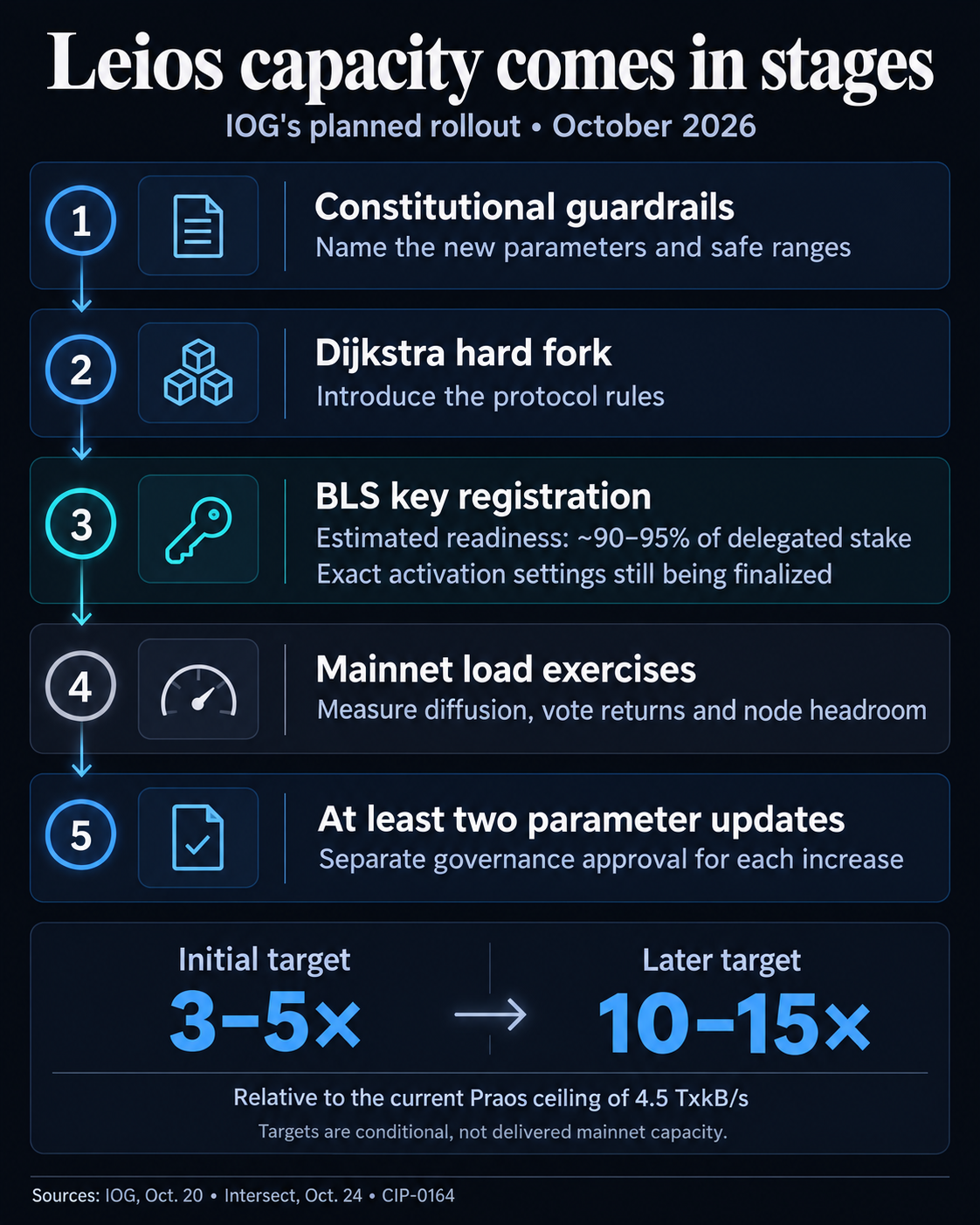
IOG estimates that registered keys should represent approximately 90% to 95% of delegated stake before activation, providing a buffer against unavailable or slow operators.
That requirement reflects Leios’ certification mechanism, which needs signatures representing at least 75% of active stake. Pools without registered BLS keys can continue producing ordinary blocks but cannot participate in endorser-block voting.
The registration process will be followed by controlled high-load exercises on Cardano’s mainnet, testing how quickly transaction batches spread across the network and whether operators can reliably certify them.
Developers will also measure spare processing capacity to determine whether nodes can withstand heavier workloads without compromising performance.
Results from those exercises will underpin proposals to increase Leios’ operating limits. Each subsequent adjustment requires 67% support from delegated representatives, 51% from stake-pool operators and two-thirds approval from the Constitutional Committee.
These changes can be enacted without another hard fork, provided they remain within the previously approved constitutional limits.